It is 2360 AD, and humanity is almost gone.
A hundred years after a mysterious pathogen turned Earth into a graveyard, the last six thousand survivors drift through the outer solar system aboard four aging ships. Water is running out. Food is rationed. The infected, called slurpers for the sound their remade lungs produce, have consumed every colony, every city, every world humanity ever built. The fleet endures on strict decontamination protocols, scarce resources, and the grim arithmetic of slow decline.
When Captain Sam James diverts his ship to investigate a derelict vessel ninety-five years adrift, the crew of RPS-47 recovers more than salvage. They recover a trail: one that leads from a sealed research outpost on Mars to an unregistered mining station at the edge of known space, and to a religious movement that has been quietly collecting pathogen samples for decades.
Then the infection breaches the fleet for the first time in thirty years, and the arithmetic changes overnight.
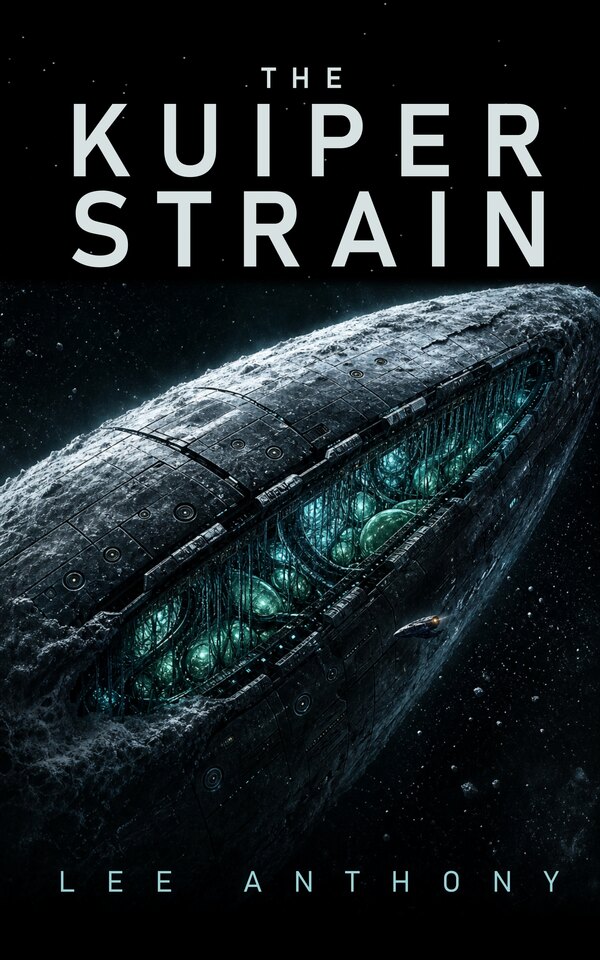
As the fleet tears itself apart over what to do, a young ensign named Emily Reese discovers that her own biology holds a clue no one expected. And the answer isn't behind them. It's ahead, in the vast dark of the Kuiper Belt, where something ancient is still moving. The Kuiper Strain is a novel about what happens after the end of the world: not the moment of collapse, but the century of survival that follows, and the discovery that the thing you've been running from might be the only thing that can save you.
The crew of the last fleet. Six thousand souls across four ships.
Four ships in loose formation. Everything humanity has left.
The unglamorous heart of the fleet. Originally built to process waste, now retrofitted as humanity’s command center and food production facility. Her carbon processor was recently converted to produce ration blocks. Captain James runs the fleet from her bridge.
RPS-47’s only stealth-capable vessel. Small, fast, and irreplaceable. When the fleet needs to approach something unknown without being seen, SC-1 is what they send.
Once a vessel for the wealthy crossing between worlds, now home to roughly four thousand civilians. Overcrowded, under-maintained, but stubbornly livable. The corridors that once offered champagne service now feature rerouted conduit and wire-held grilles.
The fleet’s backbone for fuel production and structural repair. Captain Tom Jordan runs her the way he runs everything — directly, practically, with no patience for meetings. Thirty years of machinery are in his blood.
The fleet’s only water reclamation ship. When infection strikes for the first time in thirty years, FT-38 is ground zero. Forty-one crew. One pathogen. A three-second gap in the decontamination cycle that changed everything.
The tools that keep humanity alive at the edge of extinction.
The most advanced technology created before the outbreak. A revolutionary system that mimics stellar fusion in a compact shipboard reactor, operating in a multi-stage cascade that produces thrust, breathable oxygen, and raw carbon for repairs; all from hydrogen fuel.
When the Sun Drive lights up, the exhaust signature burns golden-white, like a solar prominence trailing behind the ship. Now run-down, high-mileage, with parts impossible to find. But still breathing stars.
Full-body sealed environment suits built on an articulated tiluminum alloy framework. The fleet’s primary defense against the Kuiper Strain. An adaptive bio-filtration system screens every molecule at intake; it doesn’t need to identify a pathogen to block it. If the molecule isn’t on the whitelist, it doesn’t get in.
In extreme situations, the suit can stop the wearer’s heart and take over circulation entirely, flooding pain receptors with synthetic adrenaline. The wearer experiences heightened capability. The cost is paid when the suit lets go.
Three hundred years of expansion, collapse, and survival.
Three books. Three eras. One story of survival.
The fleet discovers the truth about the pathogen.
Before four ships drifted in the dark, there were five.
The pathogen was a message. The fleet opened the envelope.